

3. Its property tax applies only to the value of land, rather than to the value of real property or capital.
4. Estonia has a territorial tax system that exempts 100% of foreign profits earned by domestic corporations from domestic taxation, with few restrictions.
The structure of a country’s tax code is a determining factor of its economic performance. A well-structured tax code is easy for taxpayers to comply with and can promote economic development while raising sufficient revenue for a government’s priorities. In contrast, poorly structured tax systems can be costly, distort economic decision-making, and harm domestic economies.
2025 International Tax Competitiveness Index Rankings
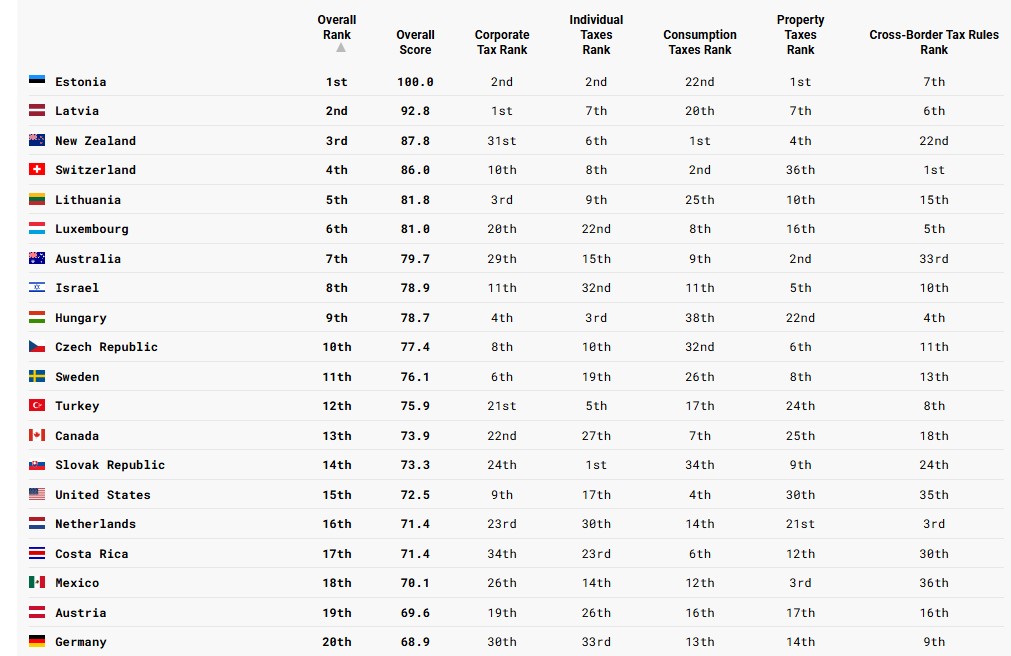
Source: 2025 International Tax Competitiveness Index
Choosing a Jurisdiction – Why Tax Matters, and What Else Counts
When entrepreneurs choose where to incorporate a company, tax competitiveness is often one of the key considerations. But it is only part of the broader picture.
Why tax competitiveness matters
Tax impacts net profitability, cash flow, and reinvestment capacity. A favourable tax system reduces overall tax burden, defers taxation (e.g. Estonia’s retained earnings model – no corporate income tax before distribution), and provides incentives for international business. Tax efficiency directly affects the economic viability of a business structure.
In our experience, taxation is one of the key factors our prospects and clients consider when choosing between Estonia and other competitive jurisdictions for incorporation.
Jurisdiction Shopping
“Jurisdiction Shopping” -this is the most direct and widely used term for choosing a country/jurisdiction that offers the most favourable tax regime, legal framework, and business environment. Entrepreneurs often engage in jurisdiction shopping, selecting countries that offer competitive tax regimes, strong legal systems, and favourable business conditions.
As corporate service providers, this is our day-to-day work guiding clients through the pros and cons of jurisdictions within the EU and beyond. Estonia is not always the best fit, and where that is the case, we leverage our network of regulated partners and associates internationally to recommend the most suitable jurisdiction. This is what we do working with regulated partners globally to identify the best-fit for you.
Several jurisdictions have positioned themselves strongly in the global market:
- Estonia – simple system, 0% tax on retained profits, strong e-Residency programme
- Malta – EU jurisdiction with flexible structures and attractive tax refund mechanisms with lowest effective corporate tax rate in Europe
- Singapore – gateway to Asia with a stable legal system and business-friendly tax regime, which is largely territorialoperating a remittance-based system
- Hong Kong – territorial taxation and strong link to China markets
- Dubai (UAE) – low-tax environment, free zones, and strategic location
All these jurisdictions combine tax advantages with other appealing features.
Tax is important, but it is only one piece of the puzzle. Here are some other non-tax key factors. In practice, non-tax factors are often just as important or even more important.
Key Non-Tax Factors in Choosing a Jurisdiction
- Availability of service providers:
- Quality and credibility of corporate service providers (CSPs).
- Quality and credibility of trust companies and fiduciaries.
- Legal system and stability: predictable, well-established legal framework.
- Variety of available structuring solutions e.g., framework for setting up trusts, private foundations, and investment funds, availability of residency programs.
- Banking access – bankability and international acceptance of a chosen corporate structure by banks and e-Money institutions globally, ability to open and maintain accounts.
- The availability of a modern, efficient digital register allowing you and service providers to manage structures remotely.
- Regulatory environment – ease of compliance, reporting requirements, cost and complexity of ongoing obligations.
- Market access – EU access (e.g. Malta, Estonia), regional hubs (e.g. Singapore, Dubai, Hong Kong).
- Reputation and credibility – perception by banks, partners, and regulators. “Clean” jurisdiction vs high-risk/offshore label.
These are just a few of the most important factors to consider when selecting a jurisdiction.
We advise prospects and clients on international options, helping choose the jurisdiction that best fits your specific needs and circumstances. Our focus is on tailored, client-specific solutions. We would be happy to support you in jurisdiction selection.
We also assist in interpreting the Estonian tax system and can help optimise and build your corporate tax structure, considering your tax residency, business operations, and the required level of substance for your corporate structure.
Whether choosing a jurisdiction or structuring your Estonian company, InCorpora is your trusted partner every step of the way.
CONTACT US NOW to learn more. We would be happy to assist you!
Team InCorpora
